The Room That Changed Everything

Updated: May 29
What Five Years in Toastmasters Taught Me About Work, Leadership, and Myself
A personal story of growth, feedback, and the unexpected lessons that followed me out of the meeting room and into every part of my professional life
I did not join Toastmasters because I was afraid of speaking. I joined because I wanted to grow. What I did not know then was just how much that one decision would end up reshaping the way I think, communicate, lead, and work.
That was 2020. Five years later, I have completed two learning paths, earned three Triple Crown awards, served as PR Lead at both Area and Division level, and held every single club officer role including Club President twice in an Advanced Club. None of that happened overnight. It happened one meeting at a time, one speech at a time, one honest piece of feedback at a time.
This is that story.

It Started With Feedback
The first time someone evaluated one of my speeches in a Toastmasters meeting, I did not know what to expect. I had given the speech. I thought it went reasonably well. And then the evaluator stood up and told me exactly what worked, exactly what did not, and exactly what to try differently next time. In front of everyone.
It was not harsh. It was specific. And that specificity was the thing I had never experienced before.
In most workplaces, feedback is vague. "Good job." "Could have been clearer." "Something to work on." It floats in the air and then disappears. Toastmasters feedback is different because it has a structure. There is a framework. The evaluator is trained to look for particular things and name them clearly.
I realised very quickly that I had never actually been taught how to give feedback. I had been improvising it my whole career.
So I started practising it. Every meeting, I paid attention to how the experienced members gave evaluations. I noticed how they framed constructive points so they landed without defensiveness. I noticed how they always anchored feedback to something specific the speaker did, not just a general impression.
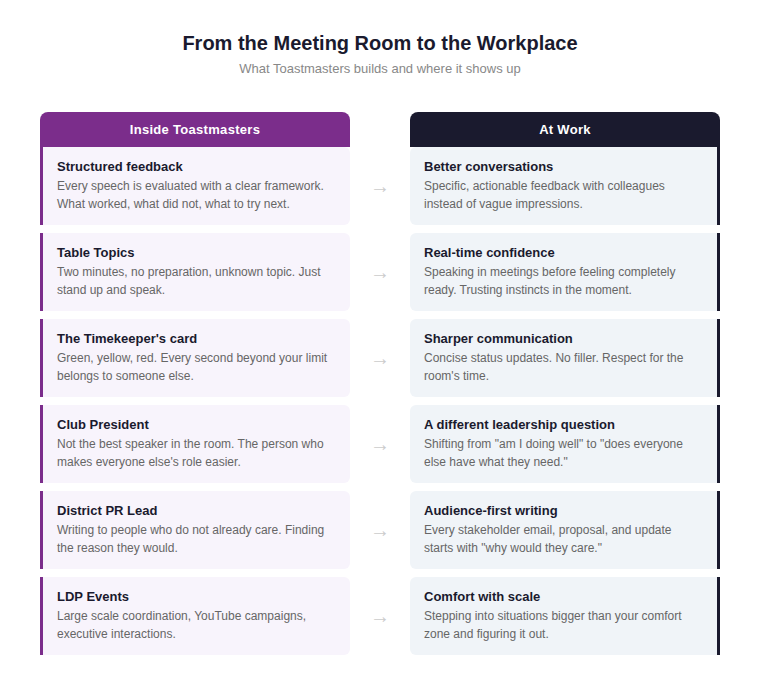
I took all of that back to work with me. And the conversations I was having with colleagues started to change. Instead of saying "that report was good," I started saying "the executive summary was really clear and the way you structured the risk section made it easy to follow." Instead of "that presentation could be improved," I started saying "the opening was strong but the audience lost the thread in the middle section, here is one thing that might help."
People noticed. And more importantly, people started giving me better feedback in return.

The Leaders Who Showed Me What Leadership Looks Like
One of the things nobody tells you about Toastmasters is how many extraordinary people you will meet inside it.
I have watched club presidents navigate difficult rooms with complete calm. I have watched members who could barely string a sentence together in their first meeting become confident, compelling speakers within a year. I have watched leaders at District level handle complex situations with a grace that I wanted to study and absorb.
These were not born leaders. They were people who had shown up, learned, practised, and earned every bit of what they became.
Being a club officer taught me that leadership is mostly about making things clear for other people. When I served as Club President, my job was not to be the best speaker in the room. It was to make sure everyone else had what they needed to do their part well. Clear expectations, a meeting that ran on time, a culture where people felt supported and challenged in equal measure.
I held that role twice in an Advanced Club. The bar is higher there. The members are more experienced, the expectations are more demanding, and the learning is proportionally deeper. It pushed me in ways a junior club simply could not.
What I carried from those roles into my professional life was a shift in how I think about running any kind of team or project. I stopped asking "am I doing my part well" and started asking "is everyone else able to do their part well." That is a different question and it leads to very different actions.
Confidence Is Not a Gift. It Is a Practice.
Before Toastmasters, I prepared extensively before any situation that felt high stakes. Presentations, important meetings, difficult conversations. I would rehearse in my head, plan every word, worry about every possible question. And still feel uncertain when the moment arrived.
The problem was not preparation. The problem was that I had not built up enough experience of walking into uncomfortable situations and discovering that I was okay.
Toastmasters builds that up, meeting by meeting. Every time you take on a role, you are doing something slightly exposed in front of other people. Table Topics, which is the impromptu speaking section of every meeting, is particularly effective at this. You are given a topic with no notice and asked to speak for two minutes. There is nowhere to hide. There is no preparation. You just have to go.
The first time I stood up for Table Topics I thought my heart was going to stop. By the hundredth time, I was thinking about what I actually wanted to say instead of thinking about the fact that people were watching me say it.
That shift transferred everywhere. I started volunteering for presentations at work instead of waiting to be assigned them. I started speaking in meetings before I felt completely ready, because I had learned that waiting for that feeling is a trap. I started trusting my own instincts in real time.
The confidence was not a gift. It was a reps count.

Time Is Not Yours Alone
The Toastmasters Timekeeper carries three cards. Green means you have reached your minimum. Yellow means you are approaching your maximum. Red means you are over.
When I first started, the red card frustrated me. I had more to say. My point was not finished. Who was this person with a card to tell me to stop?
But over time I understood what the card was actually saying. It was saying that forty people are in this room and every minute you take beyond your limit is a minute you are taking from someone else. It was not about limiting what I had to say. It was about respecting everyone else in the room.
I became obsessed with time after that. Not in an anxious way. In a respectful way.
At work, I started timing my contributions in meetings. I got sharper at distilling a status update to what the person actually needed to hear, not everything I could possibly say about it. I stopped over-explaining things to people who just needed a clear answer. I learned to trust that a well-made point delivered in one minute lands harder than the same point stretched across five.
My managers started commenting on it without knowing where it came from.
What PR at Scale Actually Teaches
Serving as PR Lead at club level is manageable. You write communications, you promote events, you keep the social presence alive.
Doing it at Area level and then at Division level is a completely different thing.
At that scale you are not writing to people who already know what Toastmasters is. You are writing to busy professionals who have never heard of it, who are skeptical of anything that sounds like a self-improvement programme, and who have every reason to scroll past what you are putting in front of them.
That forced me to learn something that sounds simple but is genuinely hard. You cannot write for yourself. You have to write for the person who does not yet care.
Every piece of communication I wrote had to start with one question. Why would this person care about this? Not why do I care. Not what do I want them to know. Why would they, given their life and their priorities and their skepticism, find this worth a few minutes of their attention?
That question follows me everywhere now. It shows up in every email I write to a senior stakeholder. Every proposal. Every project update. Every time I need to communicate something to an audience that did not ask for it, I start there.
It is one of the most useful things I have ever learned.
When Toastmasters Gave Me a Bigger Stage
At some point the club meetings were not enough. I wanted to do more and I wanted to do it at a larger scale. That is when I got applied for and got selected to the Leadership Development Programme, an initiative run by District 92.
LDP is not a speaking programme. It is a leadership programme. And the difference matters.
The work involved planning and running large scale events. The kind where a lot of things have to go right at the same time, and the margin for error is small because real people with real schedules have shown up expecting something well organised and worth their time. Coordinating logistics, managing timelines, making sure every moving part connected to every other moving part. It was project management without the job title.
We also worked on YouTube ads for the district. That was a new world for me. Writing for a screen is different from writing for a room. You have a few seconds to earn someone's attention before they move on. Every word has to justify being there. Working on those ads pushed me to think about communication in a more visual, more compressed, more intentional way than anything I had done before.
And then there were the executive leaders.
Interacting with experienced leaders at that level taught me things you cannot get from a book or a course. I watched how they made decisions quickly without having all the information. I watched how they gave direction without micromanaging. I watched how they stayed calm when plans changed, and how they spoke about the organisation with a clarity and conviction that made you want to be part of it.
I asked a lot of questions. I paid close attention. I took notes.
The LDP made me understand that leadership is not a title you are given. It is a capability you build by putting yourself in situations that are bigger than your comfort zone and choosing to figure it out.
Every time I stepped into something I was not fully ready for through the LDP, I came out the other side more capable than I went in. That is the only way it works.
The Honest Part
Toastmasters is not magic and it is not for everyone in every form.
The quality of the experience depends heavily on the club. A great club with engaged members and a genuine culture of growth is transformative. A club that goes through the motions teaches you much less. If the first club you try does not feel right, try a different one before deciding the programme is not for you.
The learning is also proportional to the effort you put in. Completing speech projects to collect credits is not the same as completing them with real intention. I got a lot out of Toastmasters because I kept raising the bar for myself. The Triple Crown is not a volume award. It represents showing up and pushing further each time.
And Toastmasters does not replace real experience. What it does is make you more ready for it. Think of it as the place where you build the foundations so that when the real moment comes, you are not starting from zero.
What I Know Now That I Did Not Know Then
I know that feedback is one of the most generous things one professional can give another. Done well, it is a form of respect.
I know that structure does not kill spontaneity. A well-run meeting, a clear agenda, a defined role for everyone in the room. These things give people the freedom to focus on what actually matters.
I know that confidence comes from doing the thing repeatedly, not from deciding you are ready to do it.
I know that time management is not a productivity hack. It is consideration for other people.
And I know that leadership is mostly about asking whether everyone else has what they need, not whether you are performing well.
Toastmasters did not hand me any of these things. It gave me a room to figure them out in, and the community to figure them out with.
Five years. Every year worth it.
If you are thinking about joining, stop thinking and go to a meeting. Most clubs welcome guests with no commitment. See what happens.
The author has been a Toastmasters member since 2020. She has completed two Pathways, earned three Triple Crown awards, served as PR Lead at Area and Division level, and held all club officer roles including Club President twice in an Advanced Club.


Well written, really appreciate your efforts and the way you described your experience. Its truly inspiring. Hope to see many such articles from your side.